Giorgia Auteri
  • Home
  • Publications
  • Odds & ends

Bats love bugs...to death!

6/16/2020

0 Comments


#AMA bats with bat expert @GiorgiaAuteri! □□ #bugscope #science #animals #scicomm #talk @periscopeco https://t.co/4EOdnoTSnS

— Isa Betancourt □□□ (@isabetabug) June 16, 2020
I was lucky enough this week to be a guest on the insect-centered Bugscope, hosted by Isa Betancourt. 'How did this happen?' you ask. 'Bats are not bugs, and also there is a pandemic going on. For shame!' Well, bats may not be bugs, but they are awfully fond of them, if you catch my drift. Many bats exclusively eat insects. Also, Isa and I are roommates, so there is no Covid-19 funny business going on.

Enjoy our musings on bats and bugs, and learn the answers to interesting questions like: Why do bats hang up-side-down? Why should you thank a bat for that tequila you may or may-not be sipping right now? How are vampire bats similar to their nefarious counterparts (besides...you know...the obvious)? And more!
0 Comments

Video feature of research on genetic susceptibility of bats to white-nose syndrome.

6/15/2020

0 Comments

 
I'm a few months behind in sharing this, but the University of Michigan news team did a great job in putting together this video, which tells the story of our recent paper on genetic susceptibility, or lack thereof, in some bats to white-nose syndrome.
0 Comments

Some silver-haired bats overwinter much farther north than previously thought

11/10/2018

0 Comments

 
This is a really nice video put together about a recent study I was part of. Thanks to University of Michigan News for putting it together.

In the paper, we describe how some silver-haired bats (Lasionycteris noctivagans) have started overwintering much farther north. Many members of this species undertake seasonal journeys between summer and winter areas. However, it appears that some of them have started hibernating about 200 miles (320 km) farther north than previously documented, with some bats staying as far as 400 miles (650 km) farther north!

So why the big shift? It may be tempting to think that climate change is responsible, but we didn't find a historical change in temperatures that matched the range shift. Rather, it seems that another anthropogenic factor is at play—some bats are learning to use buildings as their winter hide-outs! Bats in the northern wintering sites had swapped their traditional hibernation sites of tree crevices for cozy  houses, churches, and garages. While it's common for a different species of bat in the area, the big brown bat (Eptesicus fuscus), to hibernate in people's houses,  it seems like the silver-haired bat has just started to catch on to the idea.

However, for this range shift to happen, it took more than just a change in the type of hibernation site these bats use. The silver-haired bat is considered a long-distance migrant (at least compared to other migratory bats). When traveling south for the winter, some individuals must have decided to stop their journey prematurely. The supporting evidence for this is that the range shift took place along a coastline, which many bats use as a migratory "highway." So, at least two behavioral alterations had to take place: they had to change the type of hibernation site they use, and modify their migratory journey!
0 Comments

Art for communicating science: should something be left to the imagination?

7/25/2017

2 Comments

 
Many people are visual thinkers, and images have a powerful ability to shape how we understand scientific principles and concepts. The importance of art in science can be seen in the fields of scientific illustration and data visualization, among others, or by simply flipping through a textbook. In these cases, explicit visualizations help us more clearly understand a topic.

But here I want to explore a different question: What is the role for intentionally ambiguous art in science? This idea that "showing" is often better than "telling" has been well explored in written and verbal communication. You don't tell people how to feel. Rather, you evoke an emotion, feeling, or thought through subtext. Similarly, many kinesthetic, "hands on" learning experiences have also been embraced.  As we continue to expand beyond lecture-based methods for teaching and outreach, I think there is a greater role for ambiguous art in science education and for inspiring public interest in the sciences. Below, I briefly make an argument for the utility of non scientifically explicit art in each of these cases.

Ambiguous art for science education

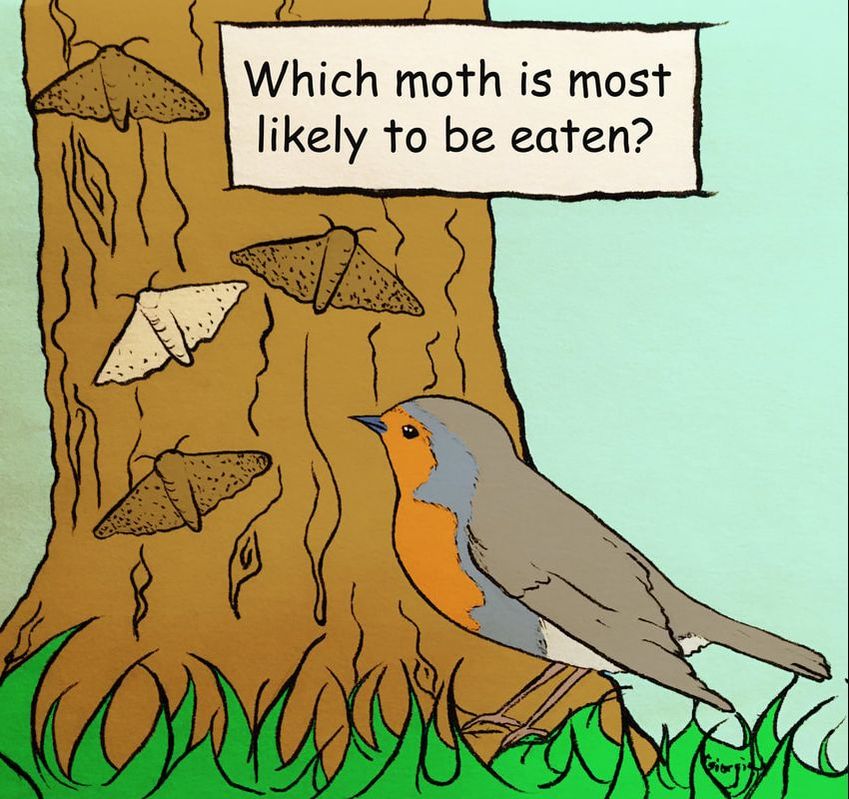
Collecting data is one thing, interpreting it is another. The below images are ones I made as part of an activity for the Ruthven Museum's Scientist Spotlight events. I was talking about natural selection, and wanted to show some classic examples. However, I ended up doing my own illustrations because it was surprisingly difficult to find what I had in mind. For the classic example of the peppered moth, web searches either showed only moths, or birds explicitly eating whichever moth stood out. While each type of image still leaves room for interpretation, I wanted pictures that allowed people to think about what was happening from step one. From that first question, you can keep asking more questions. Maybe someone answers that each moth has an equal chance of being eaten, because the bird is colorblind. Maybe they answer that the bottom moth is most likely to be eaten, because the bird doesn't want to stretch its neck. Those are fine hypotheses. The point is that you can keep asking questions about expected downstream repercussions. During that process, you are encouraging scientific thinking.
Picture
While most visitors to the museum easily explained the moth example in a traditional manner, the next illustration caused considerably more confusion. In fact, it seemed to equally perplex both 10-year-olds and the other graduate students in my lab. While everyone was more hesitant of their interpretation, even young children usually came up with an answer that described weak selection for longer necks in giraffes. Much of the indecision came from my unclear distinction between "long" versus "short" necked giraffes. Doubly perplexing, the giraffes have multiple options of what to eat.
Picture
This drawing intended to illustrate weak selection for longer necks in giraffes. The third giraffe (far right) proved particularly perplexing. This giraffe was intended to show that while short-necked giraffes could still acquire food, their options were more limited.
At the time all this confusion regarding the giraffes was unintentional. Within the first hour of going on display, I had even decided to re-make the image before the next event. However, I soon realized it was a good thing. By confusing the kids at the exhibit, I had gotten their attention, and they were more engaged in trying to figure out what was going on.
Art for outreach. Sometimes it can just be fun!

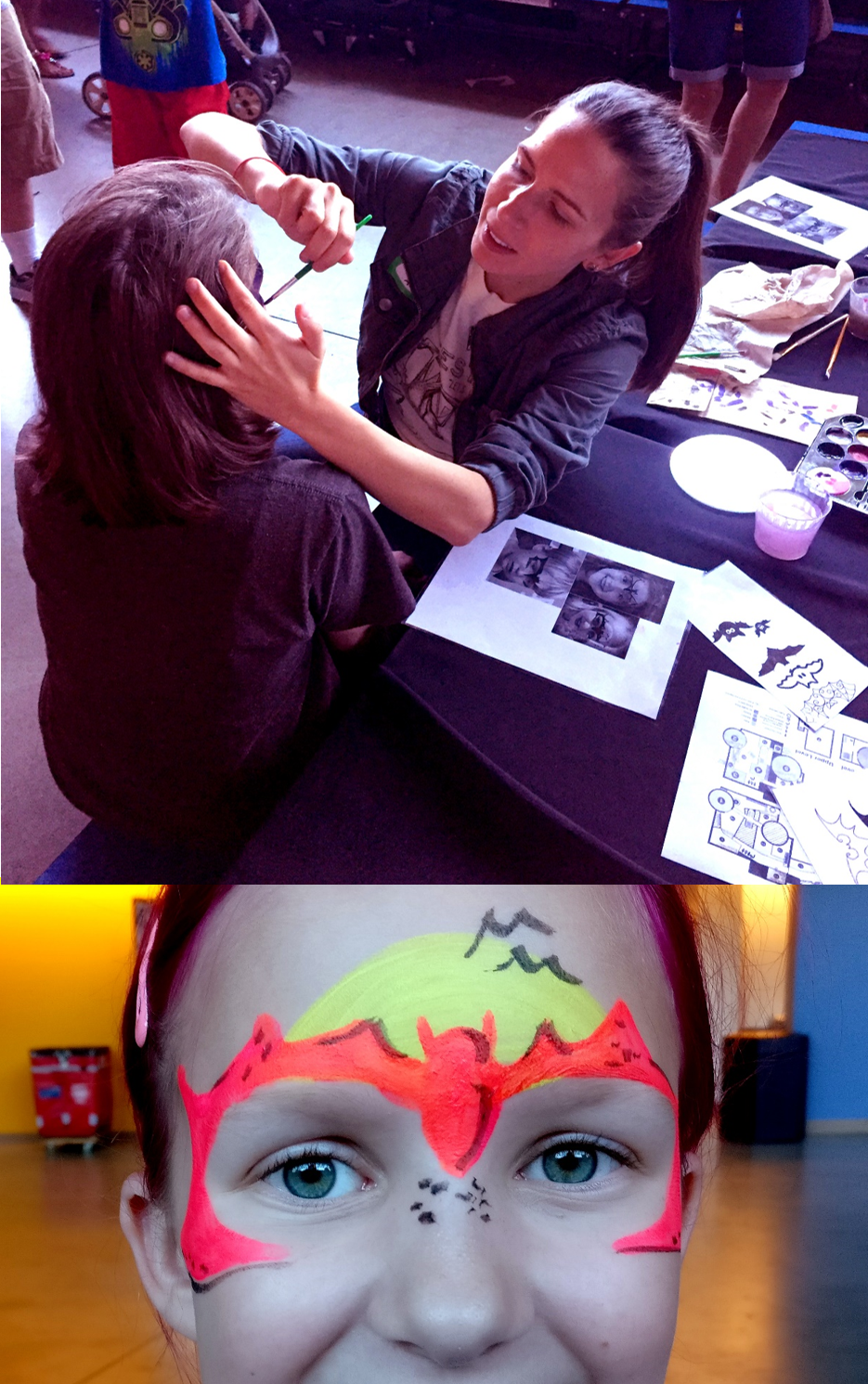
I recently did bat face painting at Michigan's Great Lakes Bat Festival. While there were plenty of hands-on educational activities I could have volunteered to help with, I pitched the idea of face painting. I wish I could say it was linked to my continued, deep contemplation of the role of art in science communication, following my experiences above. In reality, I was overworked and stressed at the time, and painting sounded like a way to unwind while also doing outreach (I had also previously painted batty faces at the Indiana Bat Festival). Both bat festivals have educational talks, learning activities, and arts and crafts. However, I like to think that having cartoonish, oddly colored bats on their faces gave kids a special appreciation for these animals. What do you think?
Picture
2 Comments

Science outreach to politicians

7/21/2017

0 Comments

 
From scientist to lobbyist

The term "lobbying" is heavy with negative connotations. Yet, the simplest definition is citizens discussing their interests with policy makers. The bad reputation stems from the disproportionate influence that some lobbyist groups exert, but that’s not the topic of this post. Rather, I want to talk about how, as a scientist, I participated in my first lobbying event.

It’s technically possible for anyone to set up a meeting with their representative or senators. However, I participated in an event where organizers set up meetings for researchers. This was the annual Biological and Ecological Sciences Coalition's (BESC's) Congressional Visits Day. The event focuses on the importance of fundamental biological research and its support by the National Science Foundation (NSF). There is a day of preparation in DC, followed by one day of meetings. I was lucky to have my participation supported through the American Society of Mammologist's (ASM's) Graduate Student Science Policy Award.
Picture
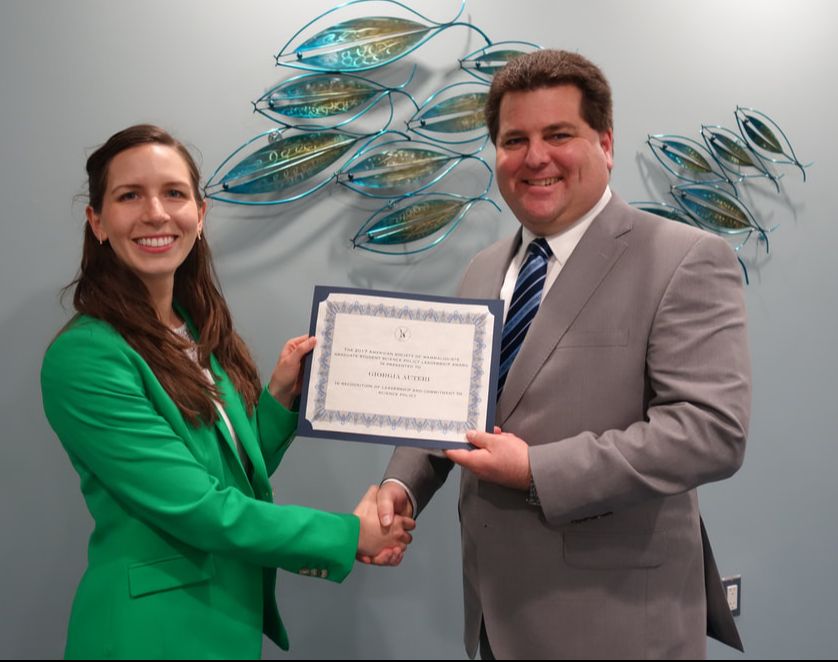
Receiving the ASM Graduate Student Science Policy Leadership award from AIBS Director of Public Policy, Dr. Robert Gropp.
What do you say to people on The Hill?

Participating in BESC greatly refined my science-communication skills. It was my first time talking with people about biology who were mildly obliged to do so, rather than particularly interested.

Honing my messaging was a learning process over the course of the meetings. Stories, experiences, and questions that resonate with people are important ways to get others interested in biology. This is true a thousand-fold when speaking to an audience with no pre-existing interest in science. During meetings, when people wrote down what I said, it was a good indicator that I had said something right. At first, I was surprised by the things that seemed to catch people’s attention, or when they asked specifically about my research. Anecdotes I considered inconsequential sparked sudden interest, lots of scribbling, and follow-up questions.

I realized that much of my science outreach (through my University of Michigan’s Ecology and Evolutionary Biology (EEB) department, the Ruthven Museum, and Organization for Bat Conservation) occurs with those who already value nature or science. This is not a representative subset of our nation’s population (high sampling bias!) and that's okay. It would not be a very interesting or productive country if we all had the same values and interests. So, my go-to anecdotes and factoids that I thought were already short and sweet, got a whole lot shorter and sweeter over the course of the day.

You can guess at someone’s values before a meeting (by looking at campaign promises or the committees they serve on), but you don't know what will resonate with someone until you sit down and talk with them. Really short anecdotes allow you to try more approaches in less time. You can find what actually interests someone! Finally, politicians are, themselves, partially in the business of passing on stories to support their points. If scientists don’t spend time talking to them, lawmakers won't have any of our stories to pass on.

A story is more persuasive than a number, but both are important when talking about budgets. Legislators are making budgetary decisions, and money is the common unit of comparison between the vastly different programs they are balancing. However, many scientists feel uncomfortable monetizing their research. I was frequently asked how my research could benefit constituents in a particular state or district. This can be scary, but it is an opportunity to find common ground with someone who doesn’t inherently value things like biology or nature. My research helps inform conservation efforts for bats. Many don't like these animals (much less "inherently value" them). However, each year bats save US farmers billions of dollars by eating insects that harm crops***. Almost every Congressperson has farmers in their district.
Picture
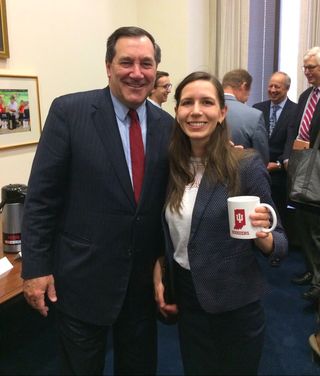
Me with Senator Joe Donnelly (D-IN) and a good cup of coffee (in a mug from my alma matar). Many congresspeople host coffee hours that are either open to the public, or scheduled for a subset of constituents.
Picture
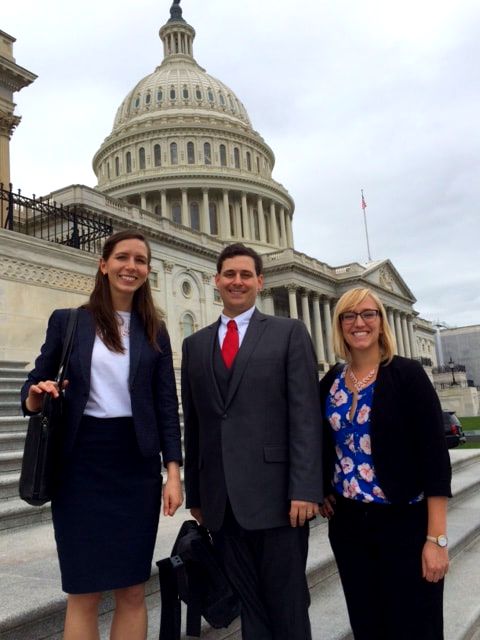
With the other two members of our BESC team, Christopher Tyrell, and Anna Groves, outside of the US Capitol Building.

​What happens at a lobbying event?

I learned a lot about the nuts and bolts of participating in a lobbying event. I wouldn’t have had any idea what I was doing if it weren’t for the guidance provided by the BESC co-hosts—the American Institute of Biological Sciences (AIBS) and Ecological Society of America (ESA). They provided information and training before the trip, hosted a prep day in D.C., scheduled meetings, and provided someone to guide teams between meetings. We were assigned groups before the event. Mine had three members, and we focused on Indiana, Michigan, and Wisconsin.

Meetings usually lasted less than 15 minutes. It’s important to be prompt, but it’s not uncommon to have to wait in the representative’s reception area for a long time. Most meetings were in a conference room or office, except one meeting in a hallway. However, we were cautioned prior to the event that it’s not uncommon to have meetings in odd places, like while a legislator was en route to the Capitol Building for a vote. However, neither a long wait nor being asked to meet somewhere unusual should be taken as a slight—it’s just how business gets done.

The people I met with were usually staff members of legislators, as opposed to the delegates themselves. These staff members typically brief the congressperson they work for at the end of the day. So, you are presenting a summarized version of a thought to someone who will re-summarize for their boss. Some staff members focus specifically on science-policy. This was the case for Michigan Senator Gary Peters. We met with his legislative fellow, who is a Knauss Sea Grant Fellow**. We also met with Senator Joe Donnelly (D-IN) and one of his staff members; Speaker Paul Ryan’s (R-WI-1) legislative director; legislative correspondents for Todd Young (R-IN), Tammy Baldwin (D-WI), and Mike Bishop (R-MI-8); legislative assistants for Ron Jonson (R-WI), and Luke Messer (R-IN-6), and a legislative aid for Debbie Stabenow (D-MI).

The start of each meeting included individual introductions and an exchange of business cards. Whoever was the lead for that meeting (whichever of us was a constituent) presented our request and provide supporting arguments. On The Hill, your request is called an "ask," and it’s expected that you state it upfront. In our case, this was to support NSF funding at $8 billion for fiscal year 2018***. Other team members chimed in when their research or experiences were particularly relevant. This also helped take some pressure off the team lead.

During meetings, we provided supporting handouts. One of these highlighted the broad importance of fundamental biological research at NSF. Another focused on state-specific benefits of NSF funding. These can be found on the AIBS public policy resources page, as “AIBS fact sheet on the value of federal research" and “CNSF state fact sheets." If we discussed it, I also left a pamphlet for EEB's NSF-funded Frontier’s Master's Program, which promotes diversity in the sciences.

After the meetings, it’s typical to follow-up via email. I contacted each person for whom I had led a meeting. I thanked them for taking the time to meet, reviewed our ask, and offered to schedule an applicable event next time the delegate is visiting their home district—for example a behind-the-scenes tour of the museum or our lab. It's also a good idea to offer yourself as a resource for relevant questions in the future.
 
A moment of silence for DDIGs

Much has been made in our community about the recent cancellation of NSF'S Doctoral Dissertation Improvement Grant (DDIG) for many of those in the biological sciences. These grants supported numerous Ph.D. projects resulting in valuable research. Not only did it have a high return on investment (ROI), but it helped early-career scientists stand out.

The DDIG program was not discussed specifically during our meetings. Budgetary allocations at these (lower) levels are at the agencies’ discretion. This is because Congress, as a whole, does not have typically have the expertise or time to allocate such funds.

The recent NSF decision highlights the complexity of pressures on executive agencies. It also underscores the need for scientists to learn more about the political process, and not simply focus more efforts on outreach and activism.

Two recent pieces in Science look at NSF and their decision more in depth: NSF Offers Arm’s-Length Defense of Trump’s 2018 Request and Ecologists Protest Sudden End of NSF Dissertation Grants.
 
For those interested in participating

This was an invaluable experience for me, and I hope that someone else from UM’s EEB department decides to take part next year. Some of the other participants came from universities where many students apply to BESC each year, and it's a point of pride for whichever lab has a student selected. I think it would be great if our department could start a tradition like that. The experience would be a good fit for anyone with an interest in politics, and who has done a lot of science outreach and communication. There are a number of societies besides ASM that sponsor students and professionals to attend BESC. These include the Ecological Society of America, the Entomological Society of America, and the Botanical Society of America, among others. Dr. Meg Duffy (also of UM EEB) recently posted about her experiences talking with policymakers in DC. 

Beyond the BESC event specifically, there are many opportunities for scientists at every stage of their career to engage with policymakers in DC and elsewhere. I encourage anyone who is interested to apply and seek out funding!

 
-Giorgia Auteri 

*    Boyles, J. G., P. M. Cryan, G. F. McCracken, and T. H. Kunz. Economic importance of bats in agriculture. Science 332:41–42.
     J. J. Maine and J. G. Boyles. 2015. Bats initiate vital agricultural interactions in corn. PNAS 112:12438–43.
 
** A number of organizations, such as the National Oceanic and Atmospheric Administration and the American Association for the Advancement of Science, offer fellowships to place scientists in positions in legislator’s offices and governmental agencies in D.C.
 
*** The FY 2018 budget is the one which is currently being formed, and which was the subject of President Trump’s widely discussed short budget. Legislators have only recently begun working on it. Now is a great time for people to contact their representatives with their thoughts. The last budget passed began development under the Obama administration.
0 Comments

    Giorgia Auteri

    Ph.D. candidate at University of Michigan

    Categories

    All
    Experiences
    Illustrating Science
    Publications
    Science Communication
    Science Policy

    RSS Feed

Powered by Create your own unique website with customizable templates.